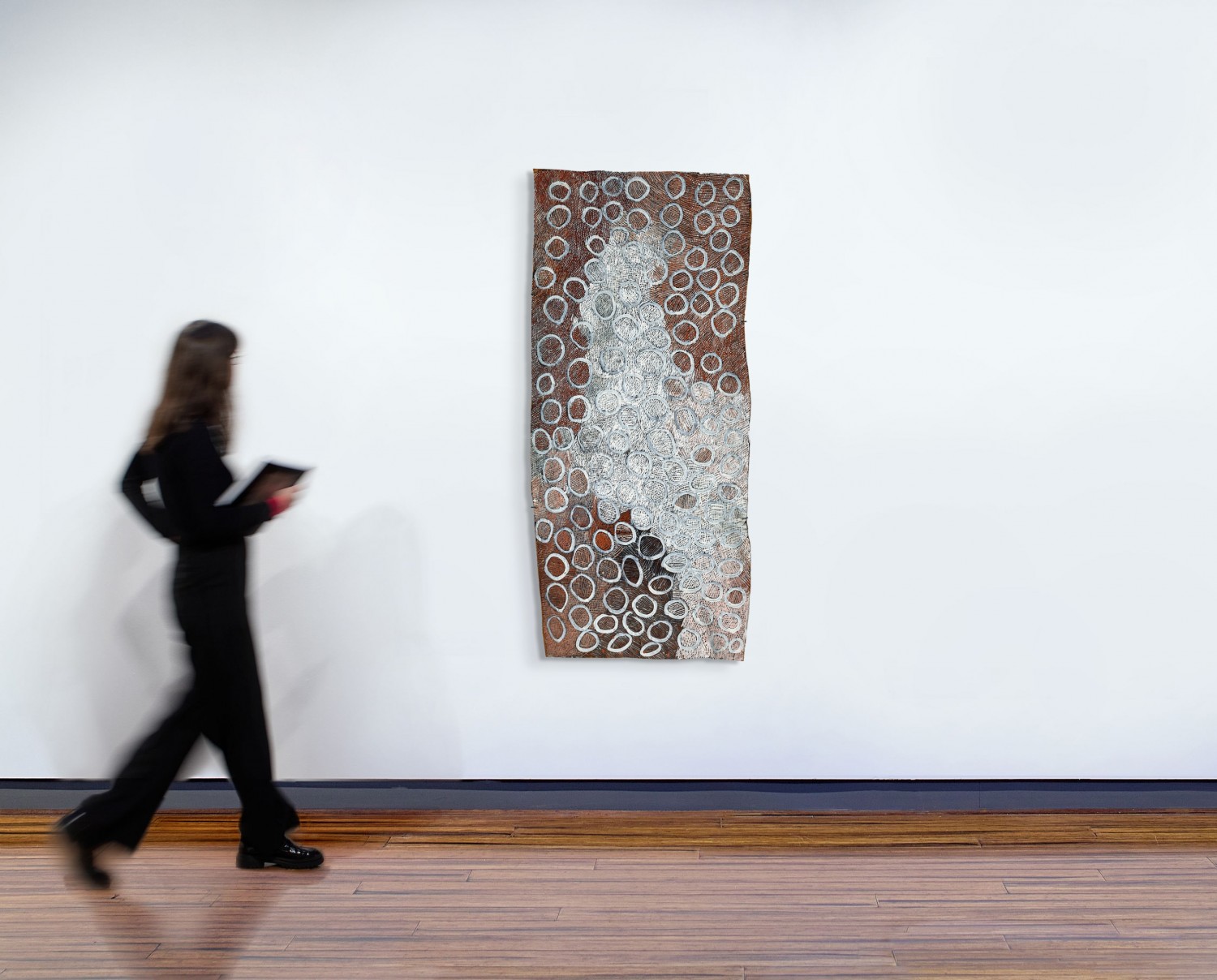
Untitled (circles), 2018
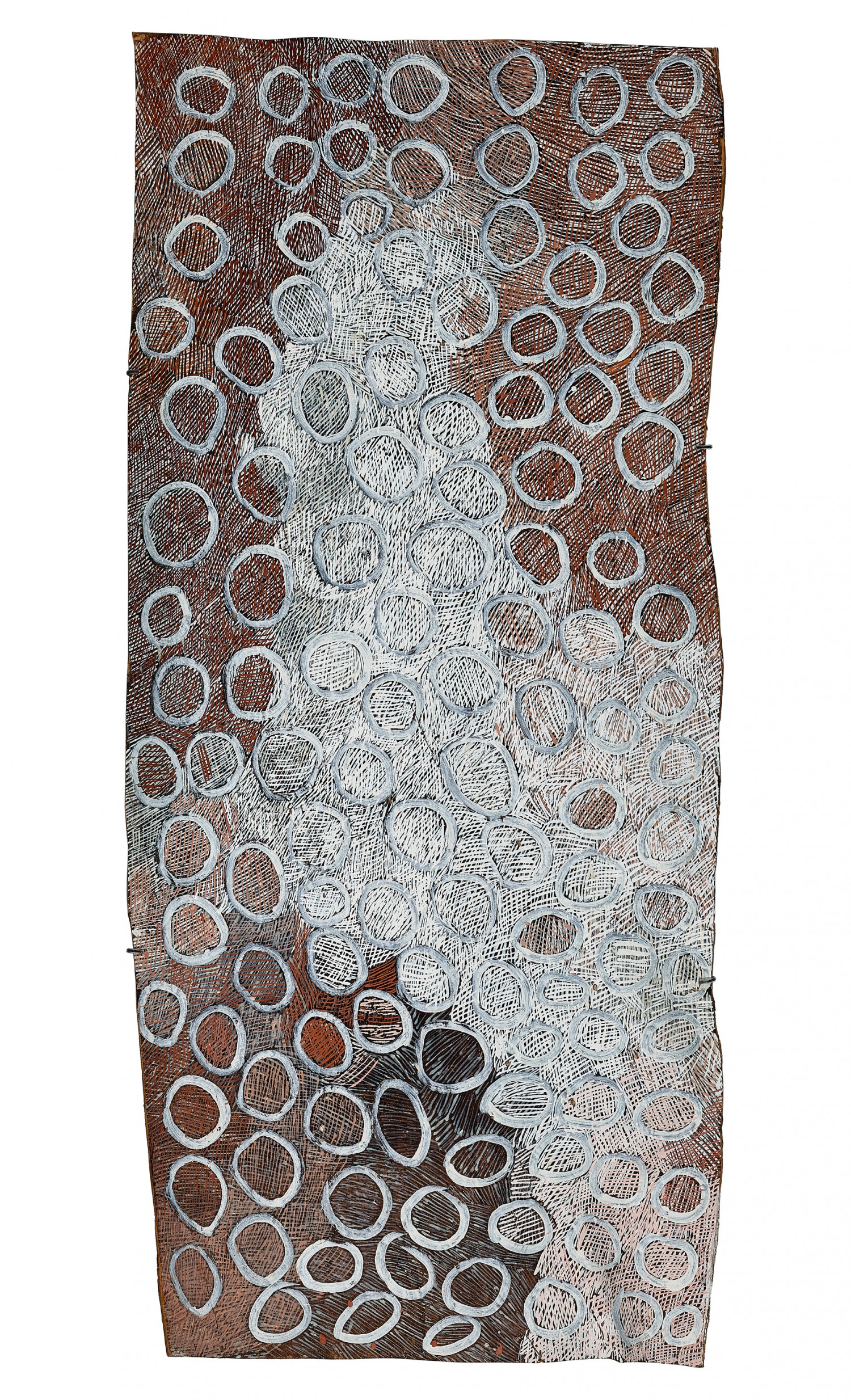
Nyapanyapa Yunupiŋu
natural earth pigments on Stringybark
168.0 x 77.0 cm (irregular)
bears inscription on Buku-Larrŋgay Mulka Centre label verso: cat. 1064-18
Buku-Larrŋgay Mulka Centre, Yirrkala, Northern Territory (label attached verso)
Roslyn Oxley9 Gallery, Sydney
Private collection, Victoria, acquired from the above
Nyapanyapa Yunupiŋu: Ganyu, Roslyn Oxley9 Gallery, Sydney, 31 January – 16 February 2019, cat. 12
Significant, D’Lan Contemporary, Melbourne, 7 May – 3 July 2025 (illus. in exhibition catalogue, p. 195)
260053.jpg
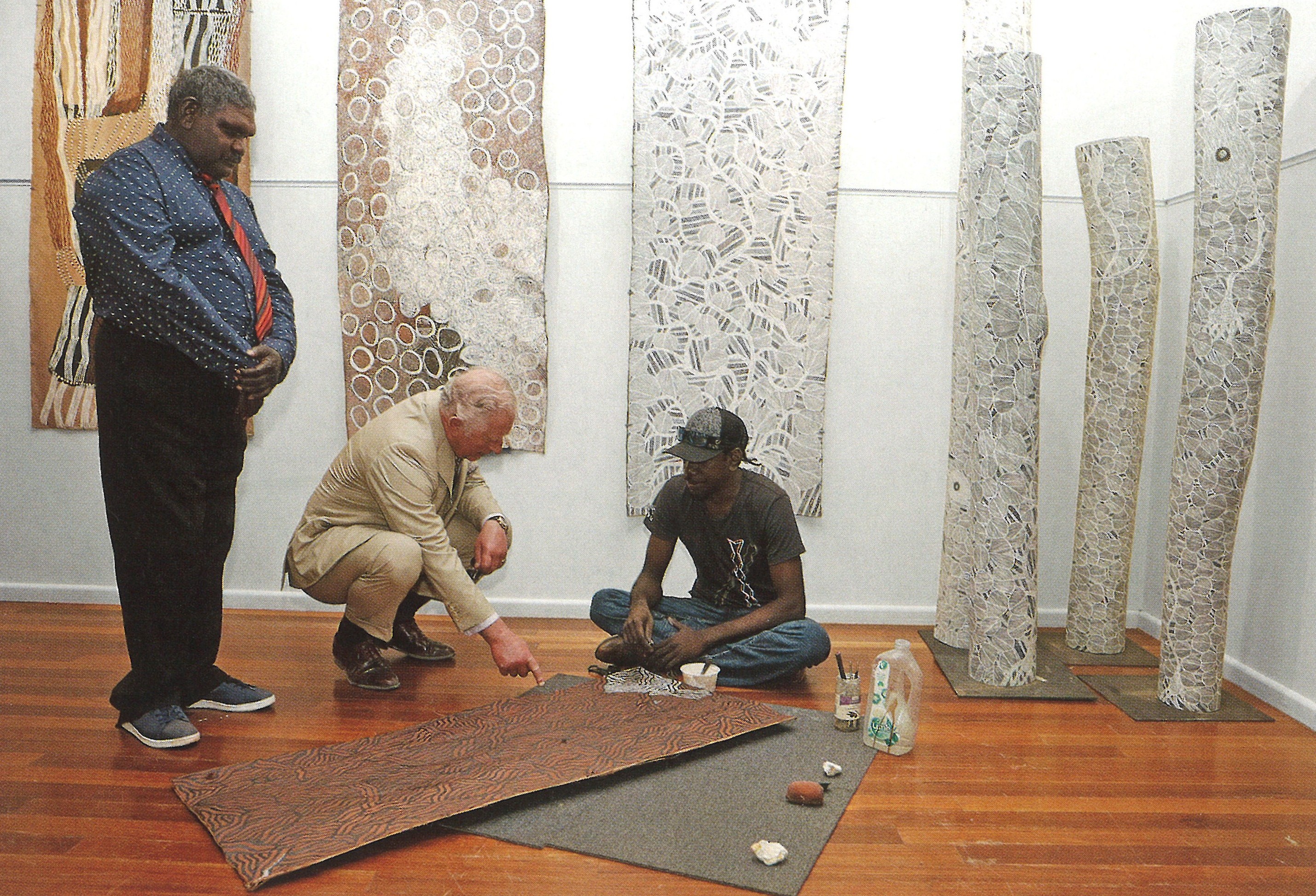
Wukun Wanambi, HM King Charles III and Barayuwa Munuŋgurr
at Buku–Larrŋgay Mulka Centre, 2018
Untitled (circles), 2018, second from left
photographer: Phil Noble
Working outside established Yolŋu conventions, the art of Nyapanyapa Yunupiŋu was distinctive and strikingly independent of Arnhem Land bark painting traditions. Celebrated for the spontaneity, texture, and freedom of her mark-making, she did not depict ancestral Dreaming narratives or traditional clan designs like many other Yolŋu artists. Instead, she created birrka ‘mirri’ – ‘anything paintings.’1 Her work is deeply personal, recalling episodes from her own life or capturing an immediate, intuitive response to the moment.
‘Yolŋu bark painting and sculpture traditionally conveys a temporal union between prehistory, the present and the distant future where all these time zones are happening simultaneously! This is the tense in which the creation events happened/are happening/will happen. All Yolngu art until this point was either sacred and in this tense or decorative. Decorative paintings were expressly ‘ordinary’ and without meaning or story of any kind.’2
However, in 2008, when she was prompted to paint the story of her near-fatal goring by a buffalo in the 1970s, Nyapanyapa departed decisively from such convention. From this point, she developed a unique body of autobiographical paintings centred on her own lived experiences.3 Her early story paintings thus quickly evolved into an idiosyncratic method of mark making combining individual free flowing elements such as circles, squares and thick lines with underlying and rhythmic cross-hatching.
Untitled (Circles), 2018 exemplifies this approach – featuring a loose constellation of white circles hovering above a dynamic ground of patterned, multihued cross-hatching. Yunupiŋu’s paintings unfold as rhythmic compositions mapped in bold gestures, employing both traditional and non-traditional materials. The looseness of her hand and her particular emphasis upon form and line lend the work an immediacy and vitality by contrast to the tightly structured geometry characteristic of many contemporary Yirrkala artists. As curator Luke Scholes observes, she ‘painted for the pure, gleeful pleasure of it. There is no ego, no desire; she instinctively and unreservedly gives herself to each mark.’4
1. Will Stubbs, cited in Scholes, L., ‘Anyhow in the everywhen’ in Luke Scholes (ed.), The Moment Eternal, Nyapanyapa Yunupiŋu, Museum and Art Gallery of the Northern Territory, Darwin, 2020 p. 133
2. Buku–Larrŋgay Mulka Centre certificate of authenticity
3. Stubbs, W., ‘The Little Things’, cited in Scholes, op. cit., p. 98
4. ibid p. 103
CRISPIN GUTTERIDGE