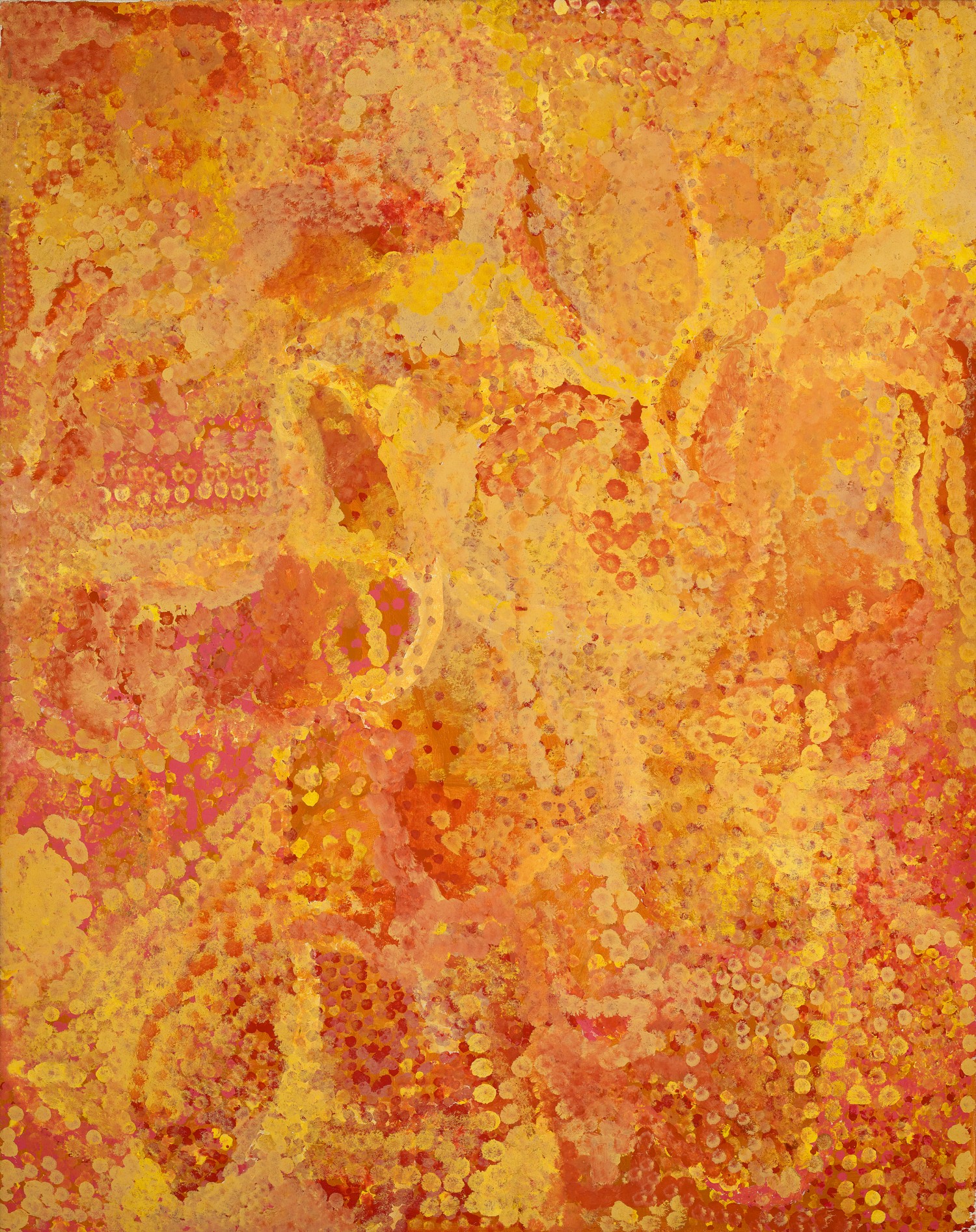
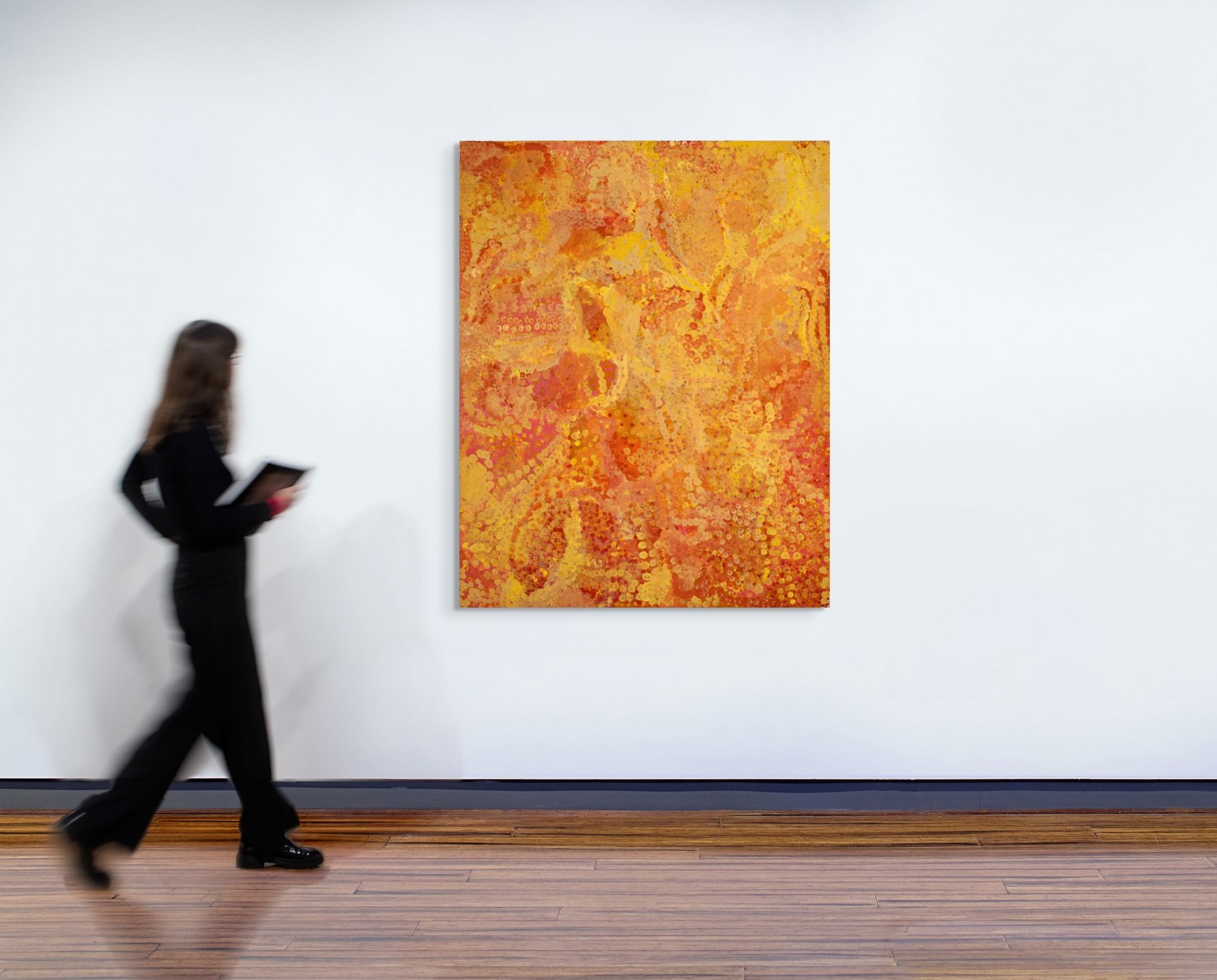
My Country, 1992
Emily Kam Kngwarreye
synthetic polymer paint on canvas
152.0 x 122.0 cm
bears inscription verso: artist's name and Delmore Gallery cat. 92HO21
Commissioned by Delmore Gallery, via Alice Springs, Northern Territory in 1992
Barry Stern Galleries, Sydney
Private collection, Sydney, acquired from the above c.1996
‘For Indigenous people, art is not something removed and separate from everyday life; It is enfolded in it. The production of art gives meaning, beauty and function to life.’1
Emily Kame Kngwarreye’s individual response in acrylic paint to the ever-changing desert country of her traditional homelands at Alhalker (Alalgura) chronicles the shifting fluctuations of the flora and landscape that surrounded her. Situated on the western edge of Utopia, this triangular tract of country was where Emily was born and where she lived according to the traditional lifeways of the eastern Anmatyerre – continuing cultural practices that long predated European settlement. Her mark-making captures the seasonal variations of the desert environment – at times subtle, at others dramatic – and the extraordinary bursts of growth that follow rain.
In her relatively short career as a painter, Kngwarreye astonished audiences by moving, seemingly effortlessly, from one distinct style to another, each emerging with remarkable assurance and completeness. This vibrant painting belongs to a group of works produced between early 1992 and late 1993, often described as her ‘high-colourist period.’2 Characterised by intensely luminous palettes, this phase saw the creation of successive paintings in brilliant, multi-hued compositions. Painted for Delmore Gallery in August 1992, this work features billowing clouds of white, pink and yellow compressed into irregular shapes and oblong forms, overlaid with sweeping lines of vivid golden and white dots that guide the viewer’s eye across the canvas. These blocks of colour are constructed through densely layered dots, creating solid, cohesive forms – a departure from her earlier, more overtly pointillist approach, in which individual layers of dots remained distinctly visible.
My Country, 1992 evokes the cycles of renewal that follow unexpected winter rains, when the desert bursts into bloom, and stands as a celebration of nature at its most vital and abundant.
1. Gilchrist, S., ‘I am Kam’, in Cole, K. et al., Emily Kam Kngwarreye, National Gallery of Australia, Canberra, 2023, p. 167
2. Neale, M. (ed.), Utopia: The Genius of Emily Kame Kngwarreye, National Museum of Australia and the National Museum of Art, Osaka, 2008, p. 149
CRISPIN GUTTERIDGE